| |
| Current Topic: Military Technology |
|
Reuters mention of Israeli cyberwar capability |
|
|
|---|
| Topic: Military Technology |
3:20 pm EDT, Sep 23, 2010 |
HOW MIGHT ISRAEL ATTACK IRAN? Overt or covert? Israel has been developing "cyber-war" capabilities that could disrupt Iranian industrial and military control systems. Few doubt that covert action, by Mossad agents on the ground, also features in tactics against Iran. An advantage of sabotage over an air strike may be deniability.
From September 2009, a few months after Stuxnet was deployed. I'd love to know the specific attribution for the text in bold. Reuters mention of Israeli cyberwar capability |
|
|
|---|
| Topic: Military Technology |
10:37 am EST, Feb 16, 2010 |
James Fallows: Retired Admiral Mike McConnell argues that we now suffer from a conspiracy of secrecy about the scale of cyber risks. No credit-card company wants to admit how often or how easily it is cheated. No bank or investment house wants to admit how close it has come to being electronically robbed. As a result, the changes in law, regulation, concept, or habit that could make online life safer don't get discussed. Sooner or later, the cyber equivalent of 9/11 will occur -- and, if the real 9/11 is a model, we will understandably, but destructively, overreact.
Tom Cross via Andy Greenberg: Internet-related companies need to be more transparent about their lawful intercept procedures or risk exposing all of their users. There are a lot of other technology companies out there that haven't published their architecture, so they can't be audited. We can't be sure of their security as a result.
Rattle: Paranoia about the conspiracy is always justified. It's just usually misplaced.
Rebecca Brock: She tells me she's ready. She may be small, she says, but she's mean. She outlines her plans for fending off terrorists. She says, "I kind of hope something happens, you know?" She wears an American flag pin on the lapel of her blazer. She sits on the jump seat, waiting for her life to change.
Decius: Wow, life is boring.
Cyber Warriors |
|
Network Attack Weapons Emerge | AVIATION WEEK |
|
|
|---|
| Topic: Military Technology |
12:10 pm EDT, May 22, 2009 |
Devices to launch and control cyber, electronic and information attacks are being tested and refined by the U.S. military and industry in preparation for moving out of the laboratory and into the warfighter's backback. This particular network attack prototype has a display at the operator's position that shows a schematic of the network of interest and identifies its nodes. "You could be talking about thousands and thousands of nodes being involved in a single mission," says a second network attack researcher. "Being able to visualize that without a tool is practically impossible." A touch-screen dashboard beneath the network schematic display looks like the sound mixing console at a recording studio. The left side lists cyberattack mission attributes such as speed, covertness, attribution and collateral damage. Next to each attribute is the image of a sliding lever on a long scale. These can be moved, for example, to increase the speed of attack or decrease collateral damage. Each change to the scales produces a different list of software algorithm tools that the operator needs. "Right now, all that information is in the head of a few guys that do computer network operations and there is no training system," says the first specialist.
The arms race advances as the Cold CyberWar rages on... Network Attack Weapons Emerge | AVIATION WEEK |
|
A Struggle Over US Cybersecurity |
|
|
|---|
| Topic: Military Technology |
11:28 am EDT, Mar 10, 2009 |
The resignation of the federal government's cybersecurity coordinator highlights a power struggle underway over how best to defend the government's civilian computer networks against digital attacks. Rod A. Beckstrom resigned the post Friday after less than a year on the job, citing a lack of funding and the National Security Agency's tightening grip on government cybersecurity matters. "He brought a completely different perspective, which in one way could have been his undoing," said a senior member of the intelligence community.
From last year's best-of: Someone needed to bring it, so I brought it.
From the archive, a personal favorite: The evidence suggests that from an executive perspective, the most desirable employees may no longer necessarily be those with proven ability and judgment, but those who can be counted on to follow orders and be good "team players."
From the documentation: MemeStreams has a reputation system, which takes your perspective into account.
From Decius, in 2007: It is our failure to avoid embracing fear and sensationalism that will be our undoing. We're still our own greatest threat.
Always the classic: Is more what we really need?
A Struggle Over US Cybersecurity |
|
SASC Criticizes Secrecy of National Cyber Security Initiative |
|
|
|---|
| Topic: Military Technology |
4:51 pm EDT, May 18, 2008 |
The committee applauds the administration for developing a serious, major initiative to begin to close the vulnerabilities in the government's information networks and the nation's critical infrastructure. The committee believes that the administration's actions provide a foundation on which the next president can build. However, the committee has multiple, significant issues with the administration's specific proposals and with the overall approach to gaining congressional support for the initiative. A chief concern is that virtually everything about the initiative is highly classified, and most of the information that is not classified is categorized as `For Official Use Only.' These restrictions preclude public education, awareness, and debate about the policy and legal issues, real or imagined, that the initiative poses in the areas of privacy and civil liberties. Without such debate and awareness in such important and sensitive areas, it is likely that the initiative will make slow or modest progress. The committee strongly urges the administration to reconsider the necessity and wisdom of the blanket, indiscriminate classification levels established for the initiative. The administration itself is starting a serious effort as part of the initiative to develop an information warfare deterrence strategy and declaratory doctrine, much as the superpowers did during the Cold War for nuclear conflict. It is difficult to conceive how the United States could promulgate a meaningful deterrence doctrine if every aspect of our capabilities and operational concepts is classified. In the era of superpower nuclear competition, while neither side disclosed weapons designs, everyone understood the effects of nuclear weapons, how they would be delivered, and the circumstances under which they would be used. Indeed, deterrence was not possible without letting friends and adversaries alike know what capabilities we possessed and the price that adversaries would pay in a real conflict. Some analogous level of disclosure is necessary in the cyber domain. The committee also shares the view of the Senate Select Committee on Intelligence that major elements of the cyber initiative request should be scaled back because policy and legal reviews are not complete, and because the technology is not mature. Indeed, the administration is asking for substantial funds under the cyber initiative for fielding capabilities based on ongoing programs that remain in the prototype, or concept development, phase of the acquisition process. These elements of the cyber initiative, in other words, could not gain approval within the executive branch if held to standards enforced on normal acquisition programs. The committee's view is that disciplined acquisition processes and practices must be applied to the government-wide cyber initiative as much as to the ongoing development programs upon which the initiative... [ Read More (0.2k in body) ] SASC Criticizes Secrecy of National Cyber Security Initiative
|
|
I Could Tell You But Then You Would Have to be Destroyed by Me: Emblems from the Pentagon's Black World |
|
|
|---|
| Topic: Military Technology |
2:24 pm EDT, Apr 1, 2008 |
Shown here for the first time, these sixty patches reveal a secret world of military imagery and jargon, where classified projects are known by peculiar names (“Goat Suckers,” “None of Your Fucking Business,” “Tastes Like Chicken”) and illustrated with occult symbols and ridiculous cartoons. Although the actual projects represented here (such as the notorious Area 51) are classified, these patches—which are worn by military units working on classified missions—are precisely photographed, strangely hinting at a world about which little is known. By submitting hundreds of Freedom of Information requests, the author has also assembled an extensive and readable guide to the patches included here, making this volume one of the best available surveys of the military’s black world—a $27 billion industry that has quietly grown by almost 50 percent since 9/11.
I Could Tell You But Then You Would Have to be Destroyed by Me: Emblems from the Pentagon's Black World |
|
|
|---|
| Topic: Military Technology |
11:25 am EST, Feb 4, 2008 |
 SIPRI data on arms transfers refer to actual deliveries of major conventional weapons. Data on arms transfers are presented in the form of SIPRI Trend Indicator Values (TIVs). TIVs are expressed in US$ m. at constant (1990) prices. However, although figures are expressed in US$, TIVs do not represent the financial value of goods transferred. Instead, TIVs are an indication of the volume of arms transferred. Hence, TIVs can be used to measure trends in international arms transfers, such as changes in the total flow of weapons and the geographic pattern of arms exports or imports. The data can also be used to measure a particular country's share of the overall import or export market or the rate of increase or decline in its imports or exports. However, since TIVs do not represent the financial value of the goods transferred, they are not comparable to official economic data such as gross domestic product or export/import figures. In order to calculate the financial value of the arms trade, the Arms Transfers Project collects official government and industry data on the value of countries arms exports. This information is available here.
"There are over 550 million firearms in worldwide circulation. That's one firearm for every twelve people on the planet. The only question is: How do we arm the other 11?" ARMSFLOW |
|
MilTrans - Voice Response Translator |
|
|
|---|
| Topic: Military Technology |
2:38 pm EST, Nov 8, 2007 |
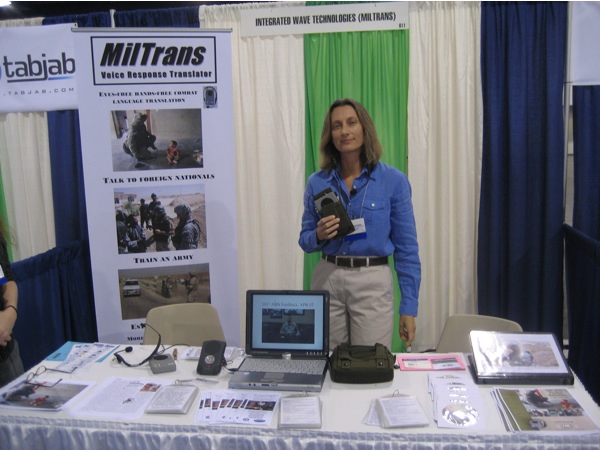
Imagine you're a soldier in Baghdad, don't speak Arabic and you must shout a command to a pack of angry-looking insurgents: "Drop your weapons!" You could fire warning shots, or take out a handheld computer and use a stylus to scroll through a list of preprogrammed phrases on a touchscreen and then flip the device around to show enemy combatants the command in Arabic. Not what you want to do in a hostile situation or combat zone. MilTrans VRT tactical eyes-free, hand-free voice translator is a solution. The device is stand alone; MICH/ACH Integrated; or Integrated into Headset with Phased Array System and Speakers.
Applications include providing instructions during force protection, house/vehicle searches, combat patrol, civil aid missions, entry control duty, basic medical triage, ship boarding and prison control.
These are our booth neighbors at Blogworld Expo. They have over 4,500 of these units in the field in Iraq and Afghanistan. This is what the wearable system looks like: MilTrans - Voice Response Translator |
|
Enlisting Madison Avenue: The Marketing Approach to Earning Popular Support in Theaters of Operation |
|
|
|---|
| Topic: Military Technology |
8:21 pm EDT, Jul 28, 2007 |
There's nothing like the right TV spot to heal the sectarian divide. Virtually every action, message, and decision of a military force shapes the opinions of an indigenous population: strategic communication, treatment of civilians at vehicle checkpoints, and the accuracy or inaccuracy of aerial bombardment. Themes of US goodwill mean little if its actions convey otherwise. Consequently, a unified message in both word and deed is fundamental to success. Business marketing practices provide a useful framework for improving US military efforts to shape the attitudes and behaviors of local populations in a theater of operations as well as those of a broader, international audience. Enlisting Madison Avenue extracts lessons from these business practices and adapts them to US military efforts, developing a unique approach to shaping that has the potential to improve military-civilian relations, the accuracy of media coverage of operations, communication of US and coalition objectives, and the reputation of US forces in theater and internationally. Foremost among these lessons are the concepts of branding, customer satisfaction, and segmentation of the target audience, all of which serve to maximize the impact and improve the outcome of US shaping efforts.
Beware the AdWords on Google Arabic: We were surprised at the success with Arabic. Keywords in Arabic were among the top performers with click-through rates often exceeding 30%.
Enlisting Madison Avenue: The Marketing Approach to Earning Popular Support in Theaters of Operation |
|
General Memetics, on Tom Ricks's Inbox |
|
|
|---|
| Topic: Military Technology |
3:57 pm EDT, Jul 28, 2007 |
Here, in a study published in June 2006 by the military's Joint Special Operations University, two "information warfare" specialists mull over how the US armed forces and intelligence agencies might influence opinion overseas through foreign bloggers: ... [I]t may be easy for foreign audiences to dismiss the US perspective with "Yes, but you aren't one of us, you don't really understand us." In this regard, information strategists can consider clandestinely recruiting or hiring prominent bloggers or other persons of prominence already within the target nation, group or community to pass the US message. ... Sometimes numbers can be effective; hiring a block of bloggers to verbally attack a specific person or promote a specific message may be worth considering. On the other hand, such operations can have a blowback effect, as witnessed by the public reaction following revelations that the US military had paid journalists to publish stories in the Iraqi press under their own names. People do not like to be deceived, and the price of being exposed is lost credibility and trust. An alternative strategy is to "make" a blog and blogger. The process of boosting the blog to a position of influence could take some time, however. ... There will also be times when it is thought to be necessary, in the context of an integrated information campaign, to pass false or erroneous information through the media ... in support of military deception activities. ... In these cases, extra care must be taken to ensure plausible deniability and nonattribution, as well as employing a well-thought-out deception operation that minimizes the risks of exposure.
General Memetics, on Tom Ricks's Inbox |
|