Matrix » [Credit Spiral] Declining Home Prices Primary Cause Of Declining Home Prices
Topic: Markets & Investing
5:57 pm EDT, May 9, 2008
There is significant locational disparity in the performance of housing markets across the country. Bernanke showed a very cool set of heat maps on a variety metrics.
The predominant view is currently biased to commodities as an investment hedge against inflation...
Unfortunately, this thinking is a self-fulfilling prophecy which ultimately may feed into a negative economic cycle where legitimate commercials are squeezed out of business thereby reducing supply, protectionism gains traction, trade breaks down, hoarding ensues, riots occur and wars erupt over access.
This may sound alarmist, but industry insiders are not buying into the one-size fits all answer that emerging economies are the primary factor driving up prices from the demand side, reinforced by supply-side shocks and peak production fears. In a slowing global economy hit by a major credit crisis and reeling from a falling dollar, it is likely that money flows seeking safe haven in hard assets is the key driver of recent volatility.....
The Big Picture | Volcker: "Bernanke a One Termer"
Topic: Markets & Investing
10:04 am EDT, Apr 14, 2008
You may not like Obama, but consider that Clinton thinks Greenspan should be a go to advisor in her administration, and that McCain has Phil Gramm running his team. I'll go w/Volcker every time thank you very much.
An interesting perspective on the upcoming election.
You're supposed to raise your standard of living by working harder, being clever, earning more income -- not by using your long-term savings. And now this current generation is pretty much fucked. When push comes to shove and they go to take money out of their houses at retirement time, they’re going to find out that there ain’t a whole lot there. They better pray that Social Security is still around in 20 years -– not exactly a sure thing.
There is the other shoe. I hadn't considered that. These people won't be able to retire! Millions of them, across the social strata. They'll have a huge house and a BMW and no retirement savings. They'll all be depending on Social Security at exactly the moment when Social Security becomes insolvent.
This essay makes another interesting point:
But you look at what FEMA did after Katrina, and you wonder, "Who’s running the ship?" This disaster is more of the same -- only it is much, much worse than New Orleans.
We saw a complete abdication of responsibility by the regulatory supervisors who oversee banking and lending institutions.
Basically, we've got more incompetent Bush Administration appointees. This is beginning, for me, to be a core reason why I don't think I'll be able to vote for McCain no matter what I think of his policy positions vis-a-vis the Democratic nominee -- its still the Republican party, and the Republican party appears to be completely infested with rubes who can't do their jobs. This keeps coming up in context after context. Unfortunately, only Hillary seems to have made an issue out of it, and ironically so as she is perceived as being part of the culture of corruption too.
A year ago, Bear Stearns was trading around $150 a share. At Friday's close, Bear Stearns's stock market value was about $3.54 billion, at $30 a share. This weekend, J.P. Morgan bought the shop for $2 a share in a stock-swap transaction, (TWO DOLLARS!), which values Bear Stearns at just $236 million. The fed announced emergency rate cuts. On Sunday night. When was the last time you recall a rate cut on a Sunday.
Iraq war 'caused slowdown in the US' | The Australian
Topic: Markets & Investing
1:20 pm EST, Feb 28, 2008
THE Iraq war has cost the US 50-60 times more than the Bush administration predicted and was a central cause of the sub-prime banking crisis threatening the world economy, according to Nobel Prize-winning economist Joseph Stiglitz....
The spending on Iraq was a hidden cause of the current credit crunch because the US central bank responded to the massive financial drain of the war by flooding the American economy with cheap credit.
"The regulators were looking the other way and money was being lent to anybody this side of a life-support system," he said.
That led to a housing bubble and a consumption boom, and the fallout was plunging the US economy into recession and saddling the next US president with the biggest budget deficit in history, he said.
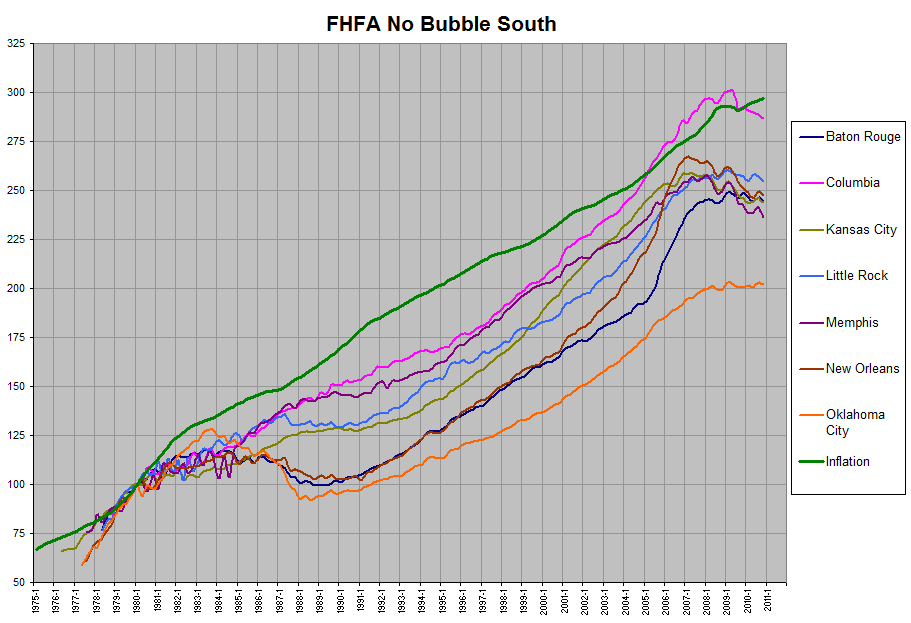
This site has some awesome housing bubble charts. Think there is no bubble in Atlanta or Nashville? Well, its certainly not as bad as a lot of areas in the country, such as Northern California:
Graphs from around the country look similar. Here is an example of cities with no bubble:
FT.com / Comment & analysis / Comment - Stop behaving as whiner of first resort
Topic: Markets & Investing
11:32 am EST, Jan 31, 2008
The same voices that supported tough macroeconomic policies to deal with the excesses of spending and borrowing in east Asia, Russia and Latin America are today pushing for a significant relaxation in the US to deal with the so-called subprime crisis...
Main Street consumers have overspent and over-borrowed and are unable to meet their obligations...
Consumption has been above sustainable levels and needs to adjust down, whatever view one has about the responsibility of adults over their financial decisions.
The adjustment of private consumption to sustainable levels is necessary, but is likely to have a negative influence in the short run on the growth of aggregate demand... put downward pressure on world growth.
Sustainable growth is not the consequence of an unsustainable consumption boom but of the progress and diffusion of science, technology and innovation...
An efficient adjustment to the US over-consumption imbalance (and Chinese under-consumption) in a way that does not hurt longer-term growth should be based on compensating for the decline of US consumption with an increase in domestic investment and in consumption abroad. It should not be based on giving the US consumer more rope with which to hang himself... giving US households a $1,000 cheque by April, a trick that no macroeconomic textbook would argue is particularly effective...
This essay is extremely clear and paints a stark picture.